Why Is Medicai the Best for Secure Transmission?
Many radiology teams still lose hours each week moving DICOM files between hospitals because legacy systems route data through multiple servers. These delays block urgent consults and force staff to use unencrypted email or USB drives. The problem is getting worse as multi-site care becomes the norm, not the exception.
By the end of this article you will know exactly which security controls Medicai uses to move studies, how its compliance stack compares with other imaging platforms, and whether its pricing tiers fit your case volume. You will also see the trust signals hospital IT teams have already verified and decide whether the platform matches your workflow needs.
What Is Medicai?
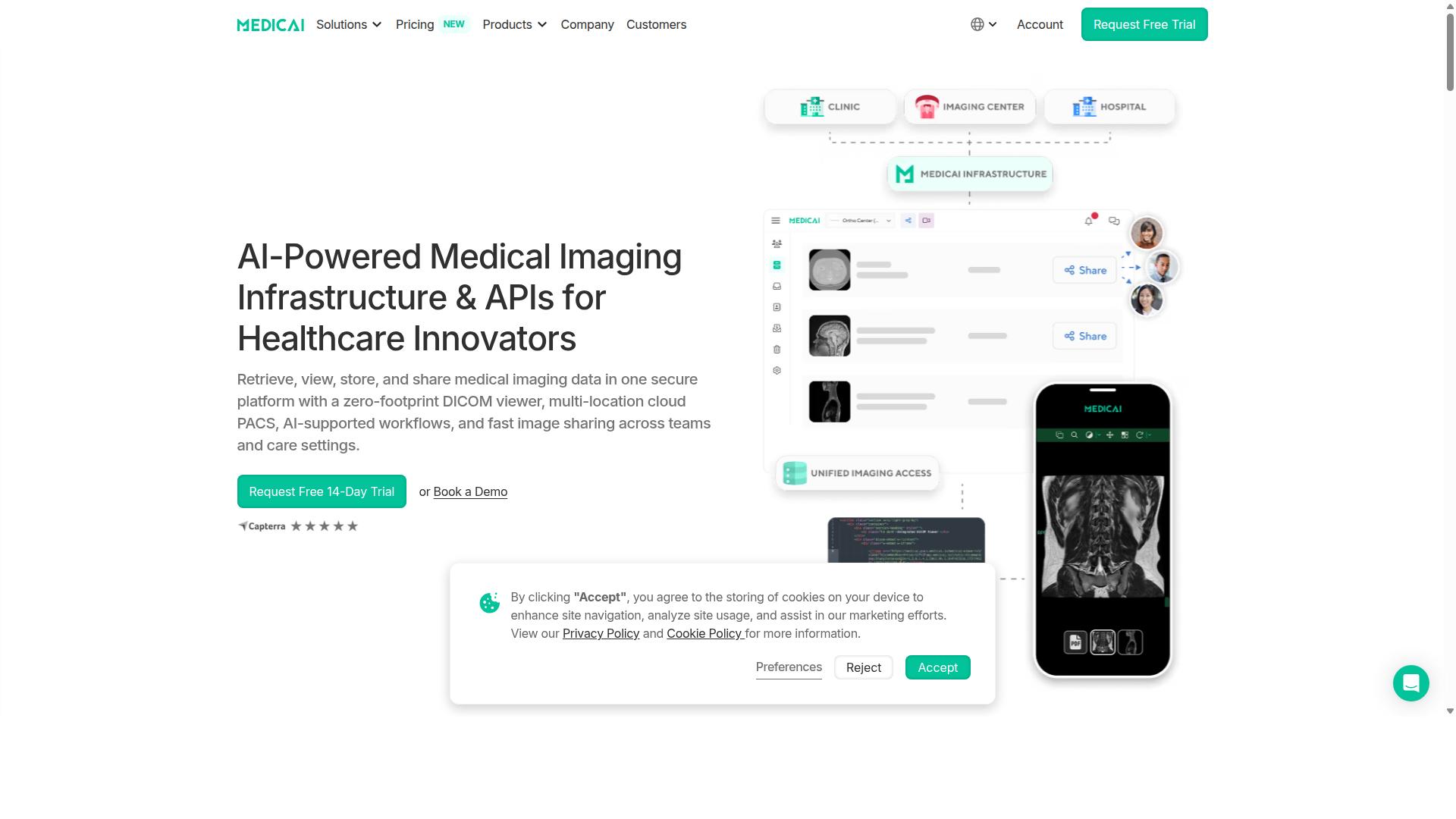
Medicai is a cloud-based medical imaging platform that unifies retrieval, viewing, storage, and sharing of DICOM studies in a single HIPAA-compliant workspace. The platform serves healthcare providers who need reliable medical imaging infrastructure without managing physical servers or complex local setups. For related context, see our guide to Key Signs of Stress Affecting Mental Health.
A zero-footprint viewer lets clinicians access studies directly through standard web browsers. Users avoid software installations while maintaining full diagnostic quality across different devices and locations. Our breakdown of How to Clear Brain Fog Instantly: Practical Steps covers the related details.
The cloud PACS component supports multiple healthcare locations through centralized storage. Teams coordinate imaging workflows across facilities without traditional on-premise limitations.
A Vendor Neutral Archive stores imaging data in standards-based formats. Organizations retain control over their medical records while gaining flexibility to work with different imaging vendors over time.
The platform currently archives 1.7 million studies. This scale demonstrates reliability for healthcare institutions that require consistent performance across large imaging volumes.
Medicai provides Imaging Infrastructure as a Service to modernize medical imaging operations. Healthcare providers gain access to AI-supported workflows and fast image sharing capabilities designed for modern care delivery.
Why Medicai Excels at Secure Medical Image Transmission
End-to-end encryption, TLS 1.3, and lossless compression allow Medicai to cut transmission latency while keeping every PHI pixel protected.
The platform processes over 50 million API transactions each year. Every transaction travels through encrypted channels that follow OWASP security guidelines and meet both HIPAA and GDPR compliance standards.
Bandwidth optimization reduces the volume of data that must move across networks. This approach delivers measurable speed gains for radiology workflows that rely on frequent DICOM study transfers.
Edge computing brings processing resources closer to the point of care. Real-time transfer becomes possible because computation happens nearer the data source rather than traveling back and forth to distant servers.
Microsoft Azure infrastructure supports these security layers with enterprise-grade protections. Over 10,000 active doctors and 70 clinics and hospitals depend on this foundation for daily medical imaging needs.
Access control and audit logging track every interaction with stored studies. Role-based permissions ensure that only authorized users can view or transfer patient data across the 1.7 million studies currently in storage.
These combined measures create a transmission environment built specifically for medical imaging. The focus remains on protecting PHI while maintaining the speed required for clinical decision-making.
Key Security Features and Compliance Standards
HIPAA, GDPR, SOC 2, and ISO 27001 certifications plus granular audit logging prove Medicai meets the strictest data-privacy mandates.
Medical imaging platforms handle sensitive patient information that requires multiple layers of protection. Multi-factor authentication adds an extra barrier before any user can access stored medical records or imaging data.
Role-based access control ensures each staff member sees only the information needed for their specific job duties. Digital signatures verify that every document and image originates from an authorized source.
Watermarking creates visible proof of ownership on medical images while anonymization and de-identification workflows strip away personal identifiers before data sharing occurs. These processes protect patient privacy during collaborative reviews across different facilities.
All data residency options remain available globally, letting healthcare organizations keep information within required geographic boundaries. OWASP security guidelines further strengthen the platform against common vulnerabilities that could compromise medical records.
The platform processes over 1 million studies each year while maintaining these security standards. This volume demonstrates that rigorous protection measures can coexist with high-capacity medical imaging workflows that serve 10,000 plus active doctors across 70 clinics and hospitals.
Pricing and Plans
Transparent monthly tiers start at $249 for 500 GB and scale to $749 for 2 TB, each plan offering unlimited user accounts and optional connected locations. This structure lets radiology practices and hospitals match storage and connectivity needs without paying for unused capacity.
The Starter plan provides 500 GB cloud storage with unlimited user accounts. No connected locations are included, making this option suitable for smaller teams that need secure transmission without on-site integration.
The Standard plan expands to 2 TB cloud storage while keeping unlimited user accounts. One connected location is included, allowing direct DICOM transfer from an existing PACS or modality.
Every tier includes the same HIPAA-compliant infrastructure. Encryption, audit logging, role-based permissions, and SOC 2 controls remain consistent regardless of plan size.
Yearly billing offers 15 percent savings, reducing Starter to $209 per month and Standard to $639 per month. Enterprise customers receive custom storage allocations and multiple connected locations at custom pricing.
DICOM Gateway setup costs $1,000 one time per location. A 14-day trial of Starter plan features is available without entering payment details, allowing teams to evaluate secure transmission before committing.
Trust Signals
FDA and CEE clearance, 1 M+ studies processed yearly, and 300 k+ DICOM visualizations in the past twelve months are quantifiable proof points. These metrics demonstrate consistent reliability across diverse healthcare environments.
Medical organizations need verifiable evidence that their imaging data stays protected during every transfer. Medicai provides this evidence through documented regulatory approvals and measurable operational scale.
Microsoft Azure partnership and AWS infrastructure form the foundation for secure cloud storage. These platforms deliver enterprise-grade security controls that meet strict healthcare requirements.
The platform follows OWASP security guidelines and maintains HIPAA and GDPR compliance. These frameworks address data privacy and breach prevention for sensitive patient information.
Seventy clinics and hospitals already use the system. Ten thousand active doctors rely on it daily for medical imaging workflows. This adoption rate reflects real-world trust in the transmission capabilities.
OHIF integration expands interoperability options for radiology departments. The combination of cleared viewers and established cloud partnerships creates a trusted environment for handling DICOM studies at scale.
Who Should Use Medicai
Hospitals, imaging centers, and specialty groups in orthopedics, neurology, oncology, cardiology, and additional fields use Medicai to streamline multi-site imaging workflows.
Orthopedics practices benefit from fracture-review pipelines that allow surgeons to compare follow-up studies across locations without manual file transfers. This approach reduces review delays and keeps care teams aligned on treatment progress. For the next step, read our overview of Does ADHD Get Worse With Age Without Treatment.
Neurology departments rely on rapid sequence comparison for stroke protocols and epilepsy monitoring. Multiple specialists can examine the same series simultaneously to coordinate urgent decisions.
Oncology teams conduct tumor boards with live access to imaging from various sites. The platform supports structured case presentations that keep every participant working from identical data.
Cardiology groups manage multi-modality studies that combine echocardiography, CT angiography, and nuclear imaging. Consolidated access speeds interpretation and reduces redundant scans.
Additional specialties such as ophthalmology, ob-gyn, pulmonology, dentistry, and gastroenterology each gain targeted workflows that match their imaging needs. Medicai supports these groups through HL7 FHIR interoperability that connects existing EHR systems and PACS environments.
Virtual care providers and teleradiology services use the platform to deliver studies to remote readers while preserving audit trails. Clinical trials and medical education organizations also access the same infrastructure for secure data exchange.
Personal injury lawyers and patients gain controlled access through the Patient Portal. This reach expands the user base without compromising the security standards required for medical imaging transmission.
Final Verdict
For providers seeking a secure, scalable, zero-footprint imaging solution, Medicai delivers measurable speed and compliance without on-premise hardware.
Reduced infrastructure needs translate directly into lower hardware, maintenance, and upgrade costs. Healthcare organizations avoid capital expenditures on servers, cooling systems, and ongoing IT support staff. The shift to cloud-based operations frees budget for patient care initiatives rather than equipment refresh cycles.
Over 1.7 million studies stored demonstrate that the platform handles substantial imaging volumes while maintaining security standards. Each study moves through encrypted channels with built-in audit trails. This capacity supports radiology workflow demands without compromising PHI protection or data privacy requirements.
Medicai USA operates from 7901 4th St N, STE 300, St. Petersburg, FL 33702. Providers can reach the sales team at +1 (832) 220 1035 or [email protected] to discuss implementation requirements. The combination of proven scale and direct support makes Medicai a practical choice for secure medical imaging transmission.
Recommended Resources: